Last updated November 17, 2026
New windows and doors improve comfort, cut energy bills and add long-term value to your home. Sightline Windows & Doors Summerlin pairs proven product lines with a local vetted installing partner for lasting performance - and a price put in writing.
Choose your installer
The unit is half the job - the install is the other half. Background-checked local installers measure, set, seal and insulate every opening, and they know the lines we quote inside and out.
Select the right products
Compare styles, materials and glass packages side by side until the fit is right for your rooms, your budget and your goals. The product-line comparison below is the place to start.
Prepare your home for install
Before install day we walk you through a short checklist - furniture pulled back, treatments down, a clear path to each opening - so install day is watch-it-happen, not scramble.
Compare the Lines We Quote
Every project is priced on the same lines, side by side - the price indicators below are relative, and your consultant shows exact numbers on your actual openings.
PGTThe line homeowners arrive naming - the most impact certifications in the industry$$$
- More impact certifications than any other line we quote
- WinGuard, EnergyVue and ClassicVue Max systems built for every wind zone
- 99% on-time delivery keeps your install date on the calendar
CGIThe heavyweight impact line$$$$$
- Large-missile impact ratings for the strictest wind zones
- Architectural-grade aluminum with commercial-depth frames
- The line we quote when protection is the whole point
CWSThe value pick$$
- Vinyl systems built to strict wind codes
- Strong energy packages at the friendliest price point
- The smart start for whole-home replacements on a budget
ESWSlim lines, big glass$$$$
- Narrow-sightline aluminum for modern elevations
- Oversized openings and floor-to-ceiling glass
- Impact-rated without the bunker look
ECOThe aluminum impact workhorse$$$
- Factory-built aluminum impact systems
- A strong price-to-protection ratio for coastal homes
- Proven lines with short lead times
Energy-Efficient Windows Troubleshooting: Common Problems and How to Fix Them
A sealed insulated glass unit fails at its perimeter, not at the glass. The argon fill leaks out through the edge seal first, and the visible fogging between the panes is the last symptom to arrive – usually months after the window has already dropped to a U-factor closer to single-pane glass. That lag is the reason so many Summerlin homeowners call us to report a “sudden” fog problem that has actually been developing for a season or two. In this guide we work through the five root causes of a window that has stopped performing, in the order we most often find them in Summerlin, and we tell you which ones you can diagnose yourself before anyone knocks on your door.
Quick Answer
Most energy-efficient window problems trace back to one of five causes: a failed insulated glass unit (IGU) seal, air infiltration at the frame, solar heat gain creep from coating degradation, sash misalignment that breaks the weatherstripping contact, or a misdiagnosis where the real problem is HVAC distribution or attic insulation. A fogging or hazy IGU and a drafty frame are usually repairable or replaceable without replacing the whole window; a glass that has failed its Low-E coating or an IGU that has lost its fill generally needs the glass unit replaced, not the frame.
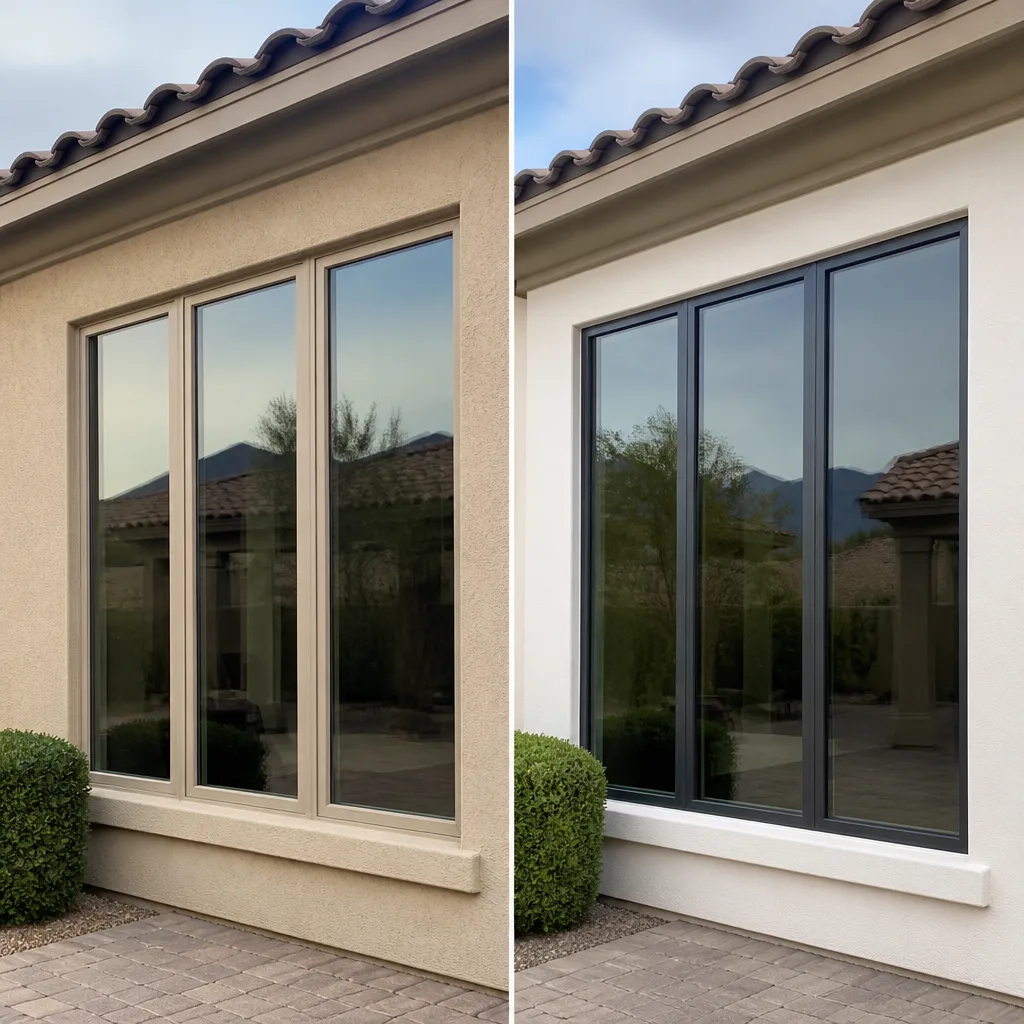
 Before
 After
Table of Contents
- 1. Failed Insulated Glass Unit Seal: The Argon Fill Diagnostic
- 2. Frame Air Infiltration: Locating and Mapping the Leaks
- 3. Solar Heat Gain Creep: Testing for Coating Degradation
- 4. Sash Misalignment and Seal Compression Loss
- 5. When It’s Not the Window: HVAC and Attic Insulation
- The Five-Minute Measurement Sequence
- Common Mistakes to Avoid
- When to Call a Professional
1. Failed Insulated Glass Unit Seal: The Argon Fill Diagnostic

An insulated glass unit is two panes with a gas fill and a desiccant spacer between them. When the perimeter seal breaks – from thermal cycling, poor original installation, or a frame that flexes – moisture enters the cavity and the desiccant eventually saturates. That’s when you see the fog. But the insulating value was compromised from the day the seal failed, not the day the fog appeared. In Summerlin’s swing between 105°F afternoons and cool desert nights, the daily expansion and contraction at the frame edge is aggressive, and we see seal failure on west and south exposures more than any other orientation.
Here is how to confirm a failed IGU seal versus a condensation problem that isn’t the glass:
- Determine where the moisture is. Fog between the panes means the sealed unit is gone. Fog on the room-side surface is interior humidity condensing on cold glass, which is a humidity problem.
- Take a surface temperature reading. An inexpensive IR thermometer pointed at the glass center and at the frame edge should show a small, predictable gap. A failed IGU will read noticeably colder in the center on a cold morning than an adjacent window that hasn’t failed.
- Watch the timing. Interior condensation appears in the morning and clears as the room warms. Seal-failure condensation between the panes does not clear with warm air – it stays.
- Check the exterior. Condensation on the outdoor pane on a hot Summerlin afternoon is normal physics, not a defect.
A failed sealed unit is replaceable as glass only if the frame and sash are sound. When we survey a Summerlin home for this, the measured survey tells us whether the frame is worth re-glazing or whether the whole opening should come out. Either way, the price is written before any work starts.
2. Frame Air Infiltration: Locating and Mapping the Leaks
Air infiltration is the second most common cause and the one most often confused with a failed IGU. The trick is timing the test. Summerlin has reliable afternoon winds in spring, and that’s when infiltration shows itself most clearly. Here’s the incense test we recommend, because it’s free and it tells you exactly where the air is entering.
- On a breezy day, close and latch the window as you normally would.
- Light an incense stick and move it slowly along the perimeter, starting at the top of the frame.
- Watch the smoke. A steady deflection toward the room means air is coming in at that point.
- Mark each deflection point with painter’s tape and photograph it.
Map what you find to the failure point, because the fix depends on it. Deflection along the glazing bead (the trim strip holding the glass in the frame) is usually a bead-seal failure. Deflection at a frame corner points to a miter or weld that has opened. Deflection at the rough opening gap – around the entire perimeter where the frame meets the wall – is an installation flashing or foam problem.
Glazing bead deflection and minor frame-corner gaps are often within reach of a careful homeowner with exterior-rated sealant. Rough opening gaps and opened frame welds are not; those require the frame to be pulled or professionally resealed. If the leak sits behind the drywall line, that’s a professional reseal. We’ve found this mapping step alone saves Summerlin homeowners from replacing windows that only needed a $40 tube of sealant and an afternoon.
3. Solar Heat Gain Creep: Testing for Coating Degradation
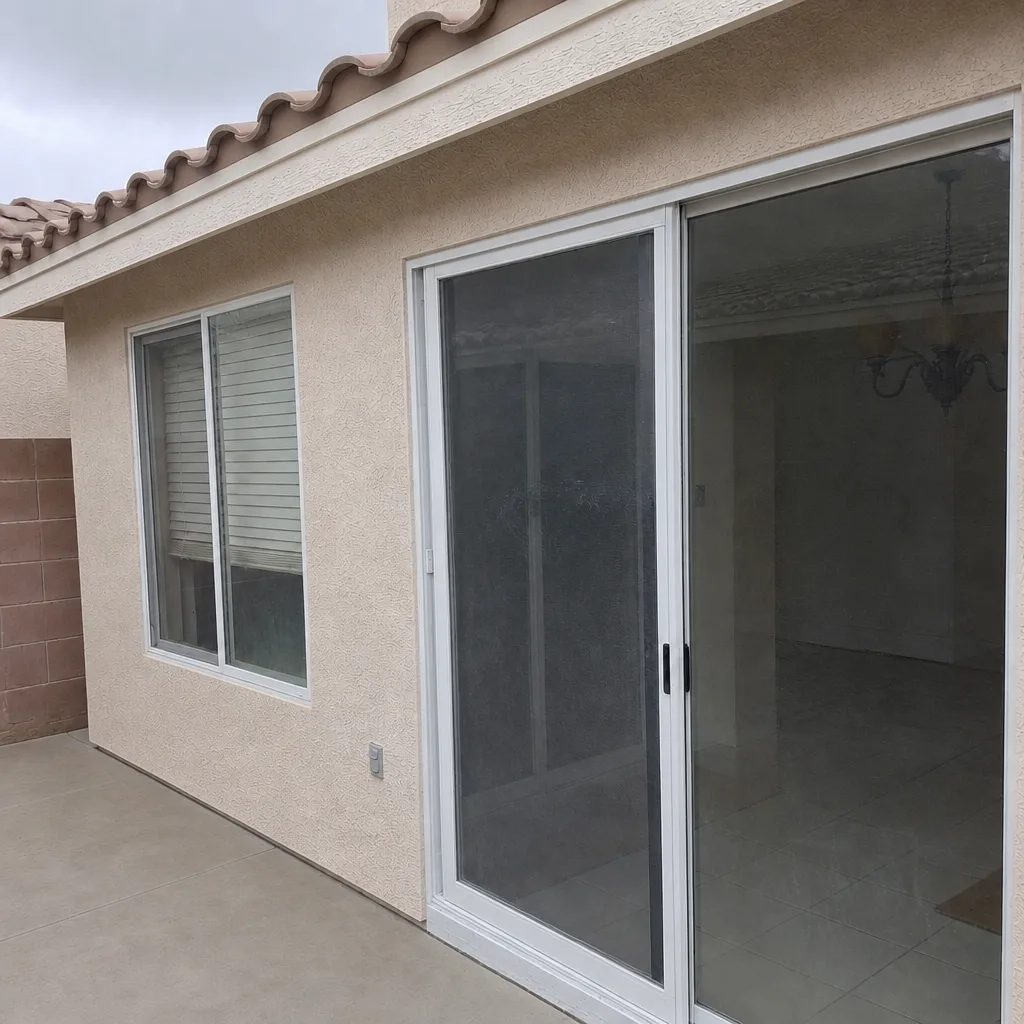
Here’s a pattern that surprises people: a window that performed beautifully at installation is letting noticeably more heat in three or four years later. Solar heat gain coefficient – SHGC, the fraction of solar heat that passes through – is set by the Low-E coating. That coating can degrade, particularly on lower-tier units exposed to unrelenting desert sun, and the degradation is invisible. The glass looks identical. The room just gets hotter.
You can test for it with an IR thermometer in mid-afternoon:
- On a sunny Summerlin afternoon, point the thermometer at the interior surface of a west or south-facing window and record the reading.
- Compare that reading to an interior glass surface on a north-facing window of the same product line at the same time of day.
- A west-facing surface running dramatically hotter than a comparable north-facing one, after accounting for sun angle, is a signal worth a professional check.
This is also the one root cause where the fix isn’t repair but specification. When a coating has degraded on a window past its serviceable life, we match the opening to a product line built for the exposure – CWS and ES Windows both carry glass packages specified by SHGC for desert sun, and the measured survey is where we pin down which one the opening actually needs. We specify by performance tier, not by what happens to be stocked.
4. Sash Misalignment and Seal Compression Loss
Weatherstripping works by compression: the sash presses into the frame and the seal closes the gap. When a sash drifts out of alignment, that contact weakens, and you get a draft that no amount of caulk will fix. On a double-hung, the tell is at the meeting rail and the side jambs. On a casement, it’s at the latch side. The measurement that matters is the gap between the sash edge and the frame, checked at the top, middle, and bottom of the sash travel.
A sash that’s out of square by roughly an eighth of an inch over its height is usually enough to leave one corner of the weatherstripping uncompressed. You’ll feel the draft before you see it. The diagnostic:
- Close the window fully and latch it.
- Run a business card around the sash perimeter. Where it slides in with no resistance, the seal isn’t compressing.
- Measure the sash-to-frame gap at the top, middle, and bottom. Note any gap that varies by more than about 1/16 inch across the sash.
- For a double-hung, check that the sash is level at the meeting rail using a spirit level.
On many modern casement and double-hung units, the hardware can be adjusted to restore alignment – hinge or roller adjustments and a re-latch. On older or heavier units, the sash may have warped past what adjustment can recover, and that’s when professional intervention makes sense. In Summerlin, where the heat cycles the frame itself, we see this most on windows that face the afternoon sun without shading.
5. When It’s Not the Window: HVAC and Attic Insulation
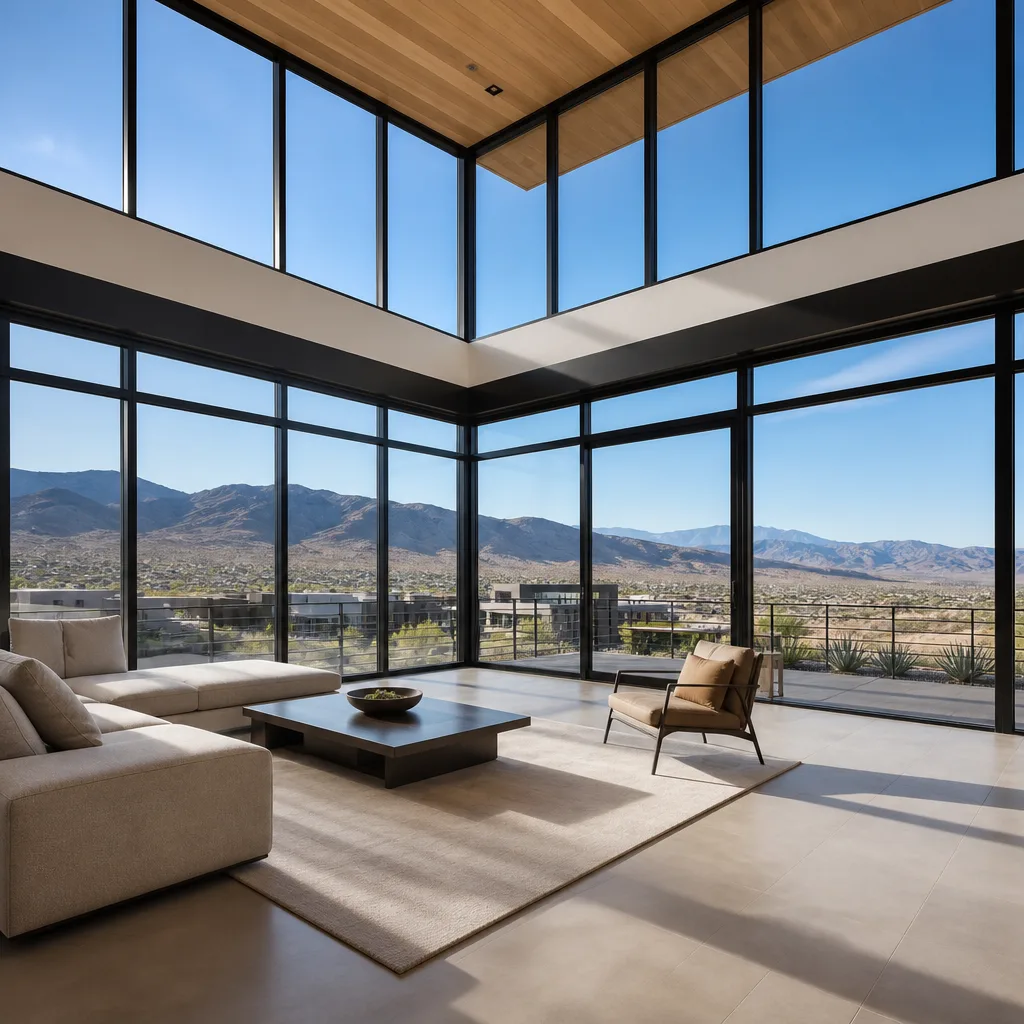
The fifth cause is the one we most want you to rule out before you spend a dollar on glass. A hot room, a drafty feel, or high bills do not automatically mean the window failed. Air distribution and ceiling insulation cause the same symptoms, and replacing windows that weren’t the problem is a costly error. Run this sequence first:
- Check the room next to the window. If an adjacent room is also uncomfortable, the issue is more likely HVAC than one window.
- Feel the supply and return registers. Weak airflow from a register serving a west-facing Summerlin room is a distribution problem, not a glazing problem.
- Check attic insulation depth above the room. Under-insulated attic space over an exposed room is a common cause of summer heat gain that gets blamed on windows.
- Do the incense test and a simple hand check before you conclude the glass is the culprit.
In our experience, a surprising share of “my windows are failing” calls resolve to an HVAC that’s short-cycling or attic insulation that’s settled. Getting that sequence right first is the difference between a glazing project and an HVAC appointment – and it’s a habit that protects your wallet. If the sequence points back to the glass, that’s when a measured survey earns its keep.
The Five-Minute Measurement Sequence
If you want a single diagnostic pass you can do before calling anyone, run these in order. It takes about five minutes and doubles as a clear record to hand a professional:
- Fog check: Is condensation between the panes or only on the room-side surface?
- Incense test: Where does the smoke deflect around the perimeter, and how many inches long is each leak?
- IR reading: Surface temperature at glass center and at frame edge, recorded on a cold morning.
- Business-card seal test: Where does the card slide in with no resistance?
- Sash gap: Top, middle, and bottom gap in inches.
- HVAC cross-check: Adjacent room comfort and register airflow.
That record is worth more than any description over the phone, and it’s the kind of documented evidence we ask our technicians to gather on every visit. When we bring the measured survey to your door under the Haven Standard, we’re reading the same numbers alongside you.
Common Mistakes to Avoid
- Caulking over a failed IGU. Sealant can’t re-fill a glass unit. If the fog is between the panes, the fix is a replacement sealed unit, not a tube of caulk.
- Assuming fog means full replacement. A sound frame and sash can often take new glass. We look at both before recommending anything.
- Sealing rough opening gaps from the interior. Interior sealant traps moisture where it can’t escape. That one belongs to professional resealing done to code.
- Testing infiltration on a dead-calm day. Wait for a breezy Summerlin afternoon or you’ll miss the leak points entirely.
- Blending interior condensation with a failed seal. Morning room-side condensation on cold glass is usually a humidity issue, not a broken unit. Check the timing before you diagnose.
- Chasing the glass before the HVAC. If two rooms are uncomfortable, the window is probably innocent. Check distribution first.
- Buying a thermometer and guessing. An IR reading is useful, but a measured survey that keeps the same numbers on the quote is what turns a reading into a decision.
If you’d rather confirm a diagnosis before you commit to any work, bring your written estimate to us for a free second opinion. We’ll review the numbers at no charge, and you’ll leave with the same document you can hold us to.
When to Call a Professional
Call a professional when you find fog between the panes, when your incense test shows leaks at the rough opening gap or an opened frame weld, when sash misalignment can’t be adjusted out of the hardware, or when the diagnostics point to a glass unit that needs to be replaced. Those are the cases where the right answer is a measured survey, a written scope, and a documented photo record – not a weekend project. Our background-checked, uniformed technicians carry license numbers to your door, and our 365-Day Done Right Promise is written into every job under the Haven Standard: if it’s not done right, we make it right. Sightline Windows & Doors Summerlin offers free estimates in Summerlin – call (844) 560-5201 to schedule yours, or bring a competitor’s quote and we’ll review it at no charge.
Frequently Asked Questions
It comes down to the frame. If the sealed glass unit has failed but the frame and sash are sound, a glass-only replacement is usually the answer. If the frame has failed its seal, warped past adjustment, or the rough opening gap needs professional resealing, replacement may make more sense. Our measured survey tells you which before any work starts, and the price is written before anyone begins.
Condensation between the panes means the insulated glass unit’s perimeter seal has failed and moisture has entered the cavity. It’s about thermal cycling and seal age, not a window that was installed wrong. Summerlin’s large day-to-night temperature swing on west and south exposures drives seal failure faster than mild climates do. Once the seal is gone, the fix is a replacement glass unit, not a caulking job.
Usually not. Condensation on the room-side surface is humidity in your house condensing on cold glass, and it clears as the room warms. Condensation between the panes is the failed seal. The timing tells them apart: room-side condensation appears in the morning and clears; between-pane fog stays. Call (844) 560-5201 for a free estimate if you’re seeing between-pane fog, and we’ll confirm the diagnosis.
Yes. Weatherstripping only seals when the sash compresses it, and a sash out of alignment by roughly an eighth of an inch over its height is enough to leave a corner uncompressed. That’s a steady draft and a real energy penalty. On many casement and double-hung units the hardware can be adjusted to restore the seal; where it can’t, we’ll tell you in writing.
Check whether more than one room is uncomfortable and feel the supply and return registers. If an adjacent room is also hot or drafty, or airflow is weak, the HVAC or attic insulation is the likelier cause, not the window. Run the incense test and hand check before deciding. If the diagnostics point back to the glass, call (844) 560-5201 for a free estimate and we’ll take it from there.
Yes. We offer free estimates in Summerlin, and every engagement starts with a measured survey you keep – the quote is the same document as the survey, so the price can’t change once work starts. Bring a competitor’s written estimate and we’ll review it free of charge. Call (844) 560-5201 to schedule.
The Bottom Line
Five root causes explain almost every energy-efficient window that stops performing: a failed IGU seal, frame air infiltration, solar heat gain creep, sash misalignment, and a misdiagnosis where HVAC or attic insulation is the real culprit. You can test for most of them yourself in about five minutes with an incense stick, a business card, and an IR thermometer. The pattern matters more than any single reading: fog between the panes and a draft at the frame are repairable or replaceable without pulling the whole window, while degraded Low-E performance usually needs new glass. Get the diagnosis in writing before you commit to anything. If you’re in Summerlin, we’ll bring the measured survey and the written price to your door.
Whether you’re weighing a repair against a full project, our team installs energy-efficient windows and doors across Summerlin and the surrounding valley, specifies each opening by its exposure rather than what’s stocked, and leaves a documented photo record when the job is done. For a free estimate and a written scope, call (844) 560-5201.
Explore our Sightline Windows & Doors Summerlin home, or jump to Window Installation in Summerlin, Window Replacement in Summerlin, and Door Installation in Summerlin for the full scope of what we do.
Written by the team at Sightline Windows & Doors Summerlin.
Six Reasons Homeowners Choose Sightline Windows & Doors Summerlin
Laminated glass and reinforced frames hold up to wind-driven rain, hail and flying debris, so your openings stay sealed when the weather turns.
Low-E insulated impact glass from our manufacturer lines commonly cuts monthly cooling bills 20-30%.
Laminated impact glass shuts out up to 40% of outside noise - traffic, neighbors, weather.
Monitoring services run $30-90 a month. Laminated impact glass resists forced entry around the clock, with no subscription.
Tighter seals and insulated glass even out hot and cold rooms and stop the drafts at the frame.
A full impact package upgrades curb appeal, buyer confidence and appraised value in one project.
Other Sightline Windows & Doors Summerlin Services
What Neighbors Say About Sightline Windows & Doors Summerlin