Last updated November 17, 2026
New windows and doors improve comfort, cut energy bills and add long-term value to your home. Sightline Windows & Doors Summerlin pairs proven product lines with a local vetted installing partner for lasting performance - and a price put in writing.
Choose your installer
The unit is half the job - the install is the other half. Background-checked local installers measure, set, seal and insulate every opening, and they know the lines we quote inside and out.
Select the right products
Compare styles, materials and glass packages side by side until the fit is right for your rooms, your budget and your goals. The product-line comparison below is the place to start.
Prepare your home for install
Before install day we walk you through a short checklist - furniture pulled back, treatments down, a clear path to each opening - so install day is watch-it-happen, not scramble.
Compare the Lines We Quote
Every project is priced on the same lines, side by side - the price indicators below are relative, and your consultant shows exact numbers on your actual openings.
PGTThe line homeowners arrive naming - the most impact certifications in the industry$$$
- More impact certifications than any other line we quote
- WinGuard, EnergyVue and ClassicVue Max systems built for every wind zone
- 99% on-time delivery keeps your install date on the calendar
CGIThe heavyweight impact line$$$$$
- Large-missile impact ratings for the strictest wind zones
- Architectural-grade aluminum with commercial-depth frames
- The line we quote when protection is the whole point
CWSThe value pick$$
- Vinyl systems built to strict wind codes
- Strong energy packages at the friendliest price point
- The smart start for whole-home replacements on a budget
ESWSlim lines, big glass$$$$
- Narrow-sightline aluminum for modern elevations
- Oversized openings and floor-to-ceiling glass
- Impact-rated without the bunker look
ECOThe aluminum impact workhorse$$$
- Factory-built aluminum impact systems
- A strong price-to-protection ratio for coastal homes
- Proven lines with short lead times
Energy-Efficient Windows Maintenance Schedule: What to Do and When
Hard water from Summerlin’s municipal supply leaves calcium carbonate on glass. That mineral film is abrasive, and the instinct most homeowners reach for – a spray bottle of ammonia-based glass cleaner – is the wrong move on a Low-E pane. Ammonia and high-alkaline cleaners attack the metallic oxide layer that does the actual work of rejecting Summerlin’s solar load, and once that layer is etched it does not come back. This guide lays out a maintenance calendar built for the high-desert West, not a national template. You’ll get the cleaning sequence, drainage timing for dust season, weatherstripping replacement thresholds with real hardness numbers, and the dated-photo protocol that keeps your warranty claim alive.
Quick Answer
Clean Low-E glass quarterly with a pH-neutral solution and a microfiber cloth, never ammonia or vinegar. Clear weep channels and frame drains every two to three weeks from May through September, the months Summerlin’s caliche dust blows in. Inspect weatherstripping every six months and replace it once it reads below roughly 50 Shore A durometer. Photograph every component with a date stamp at each service, because seal-failure warranty claims usually hinge on documented maintenance proof.
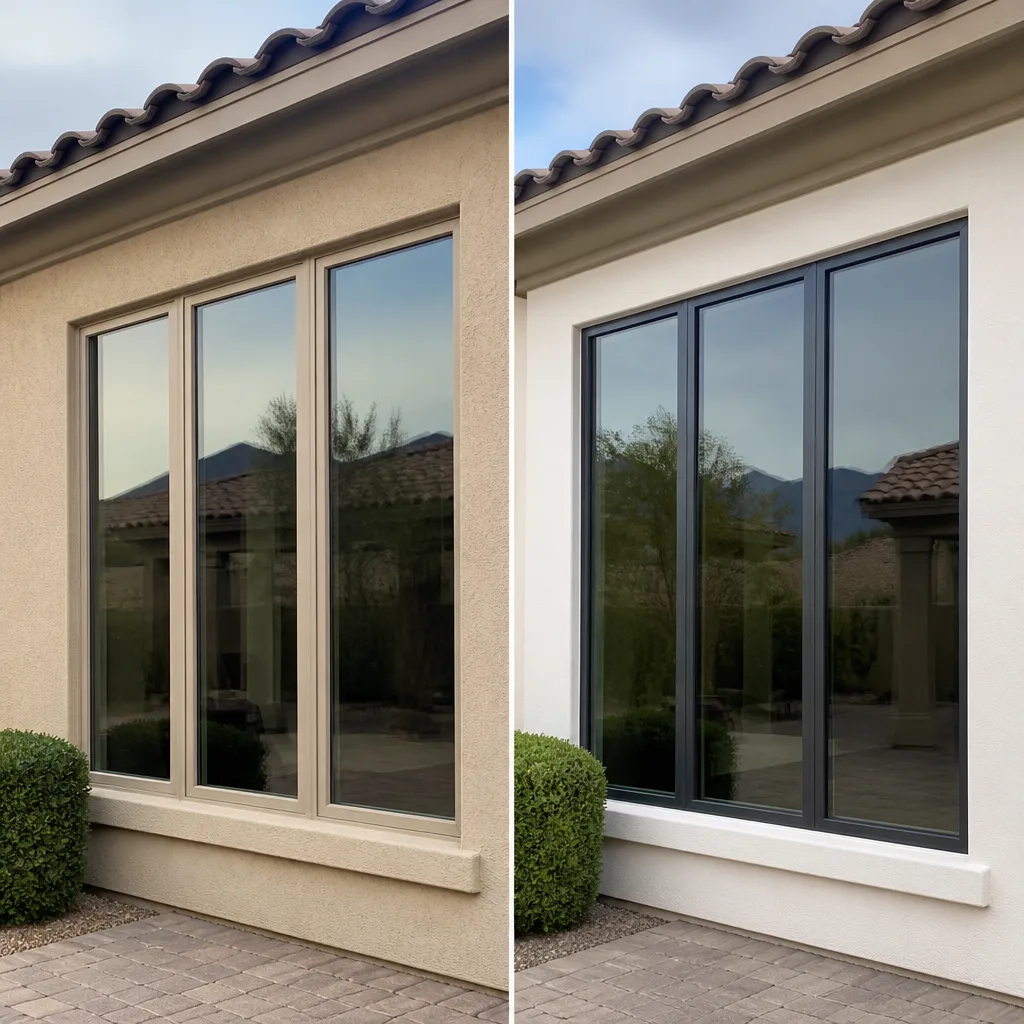
 Before
 After
Table of Contents
- How to Clean Low-E Glass in a Hard-Water Market
- Weep Channel and Frame Drainage: The Dust Season Schedule
- Weatherstripping: Durometer Readings and Replacement Intervals
- Hardware Lubrication by Mechanism Type
- The Dated-Photo Documentation Protocol
- The 12-Month Calendar at a Glance
- Pyrolytic vs. Soft-Coat Low-E: Why It Changes Your Approach
How to Clean Low-E Glass in a Hard-Water Market

Low-E works through a microscopically thin metallic oxide coating. On most windows that coating sits on an interior surface, protected from the weather but not from the wrong cleaner. Ammonia and vinegar are the two most common household glass agents, and both are the ones to keep away from these panes. Summerlin’s water carries enough dissolved calcium that even plain tap water dries into a haze, so a final rinse with filtered or distilled water saves you a second pass.
The correct sequence, in order:
- Flush loose dust off with a hose or a wet rag before touching the glass. Dry wiping grinds caliche grit across the coating.
- Wash with a pH-neutral solution – a few drops of mild dish soap in a bucket of filtered water is plenty.
- Go over the whole pane with a soft microfiber cloth, edge to edge, using light pressure.
- Rinse with filtered or distilled water to carry the soap and minerals away.
- Dry with a clean, separate microfiber cloth in a single direction.
Do this quarterly in Summerlin. If your windows face west or south into full afternoon sun over the Red Rock foothills, a fifth pass in late summer helps, because heat bakes mineral residue onto the glass faster than it does on shaded elevations. This is exactly the kind of detail a national maintenance calendar skips, and it’s why panes here can look cloudy in three years that would have stayed clear in a milder climate.
Weep Channel and Frame Drainage: The Dust Season Schedule
Every window frame has a drainage path: the weep channels at the sill and the small drain slots behind the track. These exist because windows take on water and need it to exit. In Summerlin, the failure mode combines two things. First, wind-blown caliche dust – the pale, alkaline soil that makes up much of the surrounding desert – settles into the channels. Second, summer cloudbursts wash that dust into a paste that sets like mortar when it dries.
The result is standing water in the sill track after every storm. Standing water works at the sill sealant from the inside, and that seal is what keeps moisture out of the wall cavity. This is the single most overlooked maintenance task we see in Summerlin homes, and it’s the one that produces the rot and interior water staining nobody wants to deal with.
From May through September, clear the channels every two to three weeks, and again within a day of any heavy rain event:
- Use a soft brush or a plastic-tipped tool. Metal picks scratch the anodized or painted frame and create a corrosion point.
- Push debris toward the weep holes, not away from them.
- Pour a cup of water into the track and watch it exit the weep hole. If it pools, clear the slot with a thin wire or a pipe cleaner.
- Check the exterior weep flaps – the little hinged covers – for dust jammed underneath that keeps them from dropping open.
Outside of dust season, a monthly check is enough. If a channel won’t drain even when cleared, the slot itself may be obstructed inside the frame, which is a job for someone with the right tools rather than a homeowner with a coat hanger.
Weatherstripping: Durometer Readings and Replacement Intervals
Weatherstripping is the flexible seal between sash and frame, and it’s what keeps conditioned air inside and desert dust outside. A visual inspection tells you part of the story. It tells you nothing about hardening, which is the actual failure mode. UV exposure – and Summerlin gets a hard dose of it – breaks down the plasticizers that keep the material soft. The strip looks fine and stops sealing, because it has turned brittle.
Hardness is measured in Shore A durometer. Virgin weatherstripping for residential windows typically sits in the 60 to 75 range. When a reading drops below roughly 50 Shore A, the material has lost the flexibility it needs and it’s time to replace. A cheap handheld durometer is a worthwhile tool for anyone maintaining a full house of windows. Short of that, a pressure test works: press a fingernail into the strip. If it dents and springs back, it’s alive. If it stays dented or feels like hard plastic, replace it.
Inspect every six months. Replace at these intervals:
- Foam tape seals: two to four years in Summerlin’s UV load.
- Bulb and blade seals: four to six years.
- Magnetic and kerf-mounted strips: five to eight years, sooner on south and west exposures.
Most bulb and blade profiles pull out of a kerf slot and press back in without tools, so they’re genuinely user-replaceable. Magnetic strips and integrated gaskets set into the sash frame usually call for a technician. Several of the lines we install – PGT Vinyl and CGI – use replaceable bulb profiles that make this a ten-minute job per window.
Hardware Lubrication by Mechanism Type
Moving hardware has its own schedule, and the intervals differ because the mechanisms work differently. A single oil for everything is a mistake. Use a dry PTFE or silicone spray on tracks and pivots, a light grease on gears, and nothing that leaves a tacky film to catch dust. In a desert market, a wet oil is a dust magnet, and grit in a casement operator wears the gear instead of sliding on it.
Here’s the breakdown we use:
- Casement operators and crank arms: lubricate the worm gear and pivot arm every six months. These take the most wear because they’re the most-used movable hardware. Grease on the gear, dry silicone on the pivot.
- Double-hung balances: inspect every six months, lubricate the jamb pocket and balance track annually. Wipe the track clean first. A dry silicone spray after cleaning keeps the balance riding smooth without attracting dust.
- Tilt-wash pivot bars and latches: lubricate the pivot point and latch mechanism every 12 months. These see less cycling, and over-lubrication just collects grit.
- Slider tracks: clean monthly in dust season, then apply a dry silicone spray. Never use grease on a slider track in a dusty climate.
If a crank turns hard or a balance rattles, lubrication may slow the failure but won’t reverse it. That’s worth a professional look rather than a homeowner forcing a worn part.
The Dated-Photo Documentation Protocol

Here’s the part most maintenance guides leave out. Window warranties – especially seal-failure warranties on insulated glass units – frequently require documented proof of routine maintenance to honor a claim. A failed seal that lets argon escape and fog appears between the panes is a warranty matter. But manufacturers increasingly ask for a maintenance history, and a homeowner with no records has a hard time asserting the fog was a defect and not the result of neglected drainage.
Build the evidence chain deliberately:
- Photograph each window at each scheduled service – the whole unit, plus a close-up of the sill channel, the weatherstripping, and the glass edge where the seal sits. A phone camera stamps the date automatically.
- Note the service performed, the date, and anything you noticed – a slow-draining channel, a strip that felt hard.
- Keep it in one folder or cloud album, sorted by window location. Label each window so the record maps to a specific opening, not “the hall ones.”
- Photograph any manufacturer label or serial number once, at the start, so the record ties to the exact unit.
We bring this same habit to every job – a documented photo record is standard on every installation we complete, not an add-on. If you replace windows in Summerlin, the record we leave you becomes the first entry in the maintenance file you’ll add to over the years. When a warranty question comes up, the history is already there.
The 12-Month Calendar at a Glance
A first-quarter-through-fourth-quarter view keeps the tasks from piling up. Tune the months to Summerlin’s calendar.
- January through March: Clean Low-E glass with the neutral solution. Lubricate casement operators and tilt-wash pivots. Inspect weatherstripping; take durometer readings and note any strip below 50 Shore A.
- April: Deep-clean all weep channels and drains before dust season starts. Check the exterior weep flaps. Inspect screen frames and gaskets.
- May through September: Clear weep channels every two to three weeks and after heavy rain. Wipe slider tracks monthly and dry-lubricate. Spot-check weatherstripping on sun-facing sides.
- October: Full fall inspection – glass, seals, hardware, drainage. Replace any failing weatherstripping before winter nights drop further.
- November through December: Clean glass and re-lubricate hardware. Final photo-set for the year. Confirm the documentation file is complete.
Two full photo-and-logging passes annually – spring and fall – cover most warranty requirements while keeping the record current. The targeted maintenance in between takes less time than most people expect.
Pyrolytic vs. Soft-Coat Low-E: Why It Changes Your Approach

Not all Low-E is the same, and the difference determines how much cleaning caution you need. Pyrolytic Low-E, sometimes called hard-coat, has the coating fused to the glass while it’s still molten. It’s durable enough to survive ordinary handling, and aggressive cleaning matters less. Soft-coat Low-E is applied after the glass is made, and the coating is delicate enough that it usually goes on the interior-facing surface of the outer pane, shielded from the weather but not from the wrong cleaner.
On a hard-coat pane, a mild cleaner causes little trouble. On soft-coat, ammonia and high-alkaline products are the problem – they can attack the oxide layer over repeated contact, and the damage shows up as a faint iridescence or a patch that no longer rejects solar heat the way it did. Most of the energy-efficient windows we install in Summerlin – including the ViewLux and ES Windows lines – use soft-coat coatings to hit the solar-heat-gain numbers this climate needs. That’s exactly why neutral cleaning matters here rather than being generic advice.
If you’re not sure which coating you have, treat the pane as soft-coat. It’s the cautious side of the question, and the trade-off is a cleaning task that costs a little more effort once a quarter.
Common Mistakes to Avoid
- Reaching for ammonia-based glass cleaner on Low-E. It’s the default in most homes and the worst choice for a soft-coat pane. Use pH-neutral solution instead.
- Wiping a dry, dusty window. Summerlin’s caliche grit acts like sandpaper. Rinse the dust off before any cloth touches the glass.
- Skipping weep channels in dust season. A blocked channel holds standing water against the sill seal. This is the slow path to wall-cavity moisture.
- Judging weatherstripping by looks alone. Hardened, still-pliable-looking seals leak. Pressure-test it or read it with a durometer.
- Greasing slider tracks and hardware. Wet oil traps desert dust and grinds the mechanism. Dry silicone is the right product here.
- Never taking dated photos. A warranty claim on a fogged unit is much harder to win without a maintenance record to back it up.
- Replacing a whole window for a failed seal. A fogging insulated unit is often a glass-unit replacement, not a new window. Get it assessed before assuming the worst.
When to Call a Professional
Some of this work belongs in your hands; some doesn’t. Call a professional when you see fog or condensation between the panes, which points to a failed sealed unit and a possible warranty claim. Call when a channel won’t drain even after clearing, or when water is staining the interior wall around a window. Call when a crank turns hard or a balance has gone loose, because forcing a worn mechanism turns a small repair into a larger one. And call before you file a warranty claim, since a written record of the condition helps.
The windows we install – whether from PGT, CGI, or other lines – carry their own documentation. Untrained hands on a failed seal or a stuck operator usually cost more than a service call. Sightline Windows & Doors Summerlin offers free estimates in Summerlin – call (844) 560-5201. We put the price in writing before any work begins, and a measured survey you keep is the first document, not the last. Explore our window replacement in Summerlin page if you’re weighing repair against replacement, or our window installation in Summerlin page for a new opening.
Frequently Asked Questions
No – skip both on Low-E glass in Summerlin, especially soft-coat panes. Vinegar is acidic and ammonia-based cleaners are alkaline, and both can degrade the metallic oxide coating over repeated use. Use a pH-neutral dish-soap solution and rinse with filtered water instead.
Every two to three weeks from May through September, and again within a day of any heavy rain event. Blown-in caliche dust settles into the channels and sets when it gets wet, so this is the highest-frequency task on the Summerlin calendar. Out of dust season, monthly is fine.
Press a fingernail into the strip. If it dents and springs back, it’s still working. If it stays dented or feels like hard plastic, it’s lost its flexibility and needs replacing – below roughly 50 Shore A durometer, it’s time. Visual inspection alone won’t tell you, because hardened strips can still look intact.
Many seal-failure warranties do ask for documented routine maintenance before honoring a claim. Photograph each window with a date stamp at every service and keep the photos in one file. A maintenance history that shows regular cleaning and drainage care makes a fogged-unit claim much easier to support.
Often yes – a fogged insulated glass unit usually means the sealed glass assembly failed, not the frame. In many cases the glass unit is replaced while the frame stays. Have it assessed before assuming you need a full replacement, and bring any written estimate to us for a free second opinion.
Dry PTFE or silicone spray on tracks, pivots, and slider channels; light grease on casement worm gears only. Avoid wet oils, because in Summerlin’s dust they turn tacky and collect grit that wears the mechanism. Clean the track before you spray anything.
The Bottom Line

Energy-efficient windows earn their rating through seals and coatings, and Summerlin’s hard water, alkaline dust, and intense UV wear both faster than a generic calendar assumes. Clean Low-E with neutral solution and filtered water, quarterly. Clear weep channels every two to three weeks through dust season. Read weatherstripping hardness twice a year and replace below about 50 Shore A. Lubricate hardware by mechanism, with dry products. And photograph it all, dated, because the record is what protects your warranty. None of this is complicated. It’s just timed for the climate you actually live in. When you need fresh windows or a seal assessed, the Sightline Windows & Doors Summerlin home page and our door installation in Summerlin page are good starting points.
Call (844) 560-5201 to schedule your free estimate. We’ll put the price in writing before any work starts, answer the phone live whenever you call, and leave you the same documented photo record we’d want on our own windows.
Written by the team at Sightline Windows & Doors Summerlin.
Six Reasons Homeowners Choose Sightline Windows & Doors Summerlin
Laminated glass and reinforced frames hold up to wind-driven rain, hail and flying debris, so your openings stay sealed when the weather turns.
Low-E insulated impact glass from our manufacturer lines commonly cuts monthly cooling bills 20-30%.
Laminated impact glass shuts out up to 40% of outside noise - traffic, neighbors, weather.
Monitoring services run $30-90 a month. Laminated impact glass resists forced entry around the clock, with no subscription.
Tighter seals and insulated glass even out hot and cold rooms and stop the drafts at the frame.
A full impact package upgrades curb appeal, buyer confidence and appraised value in one project.
Other Sightline Windows & Doors Summerlin Services